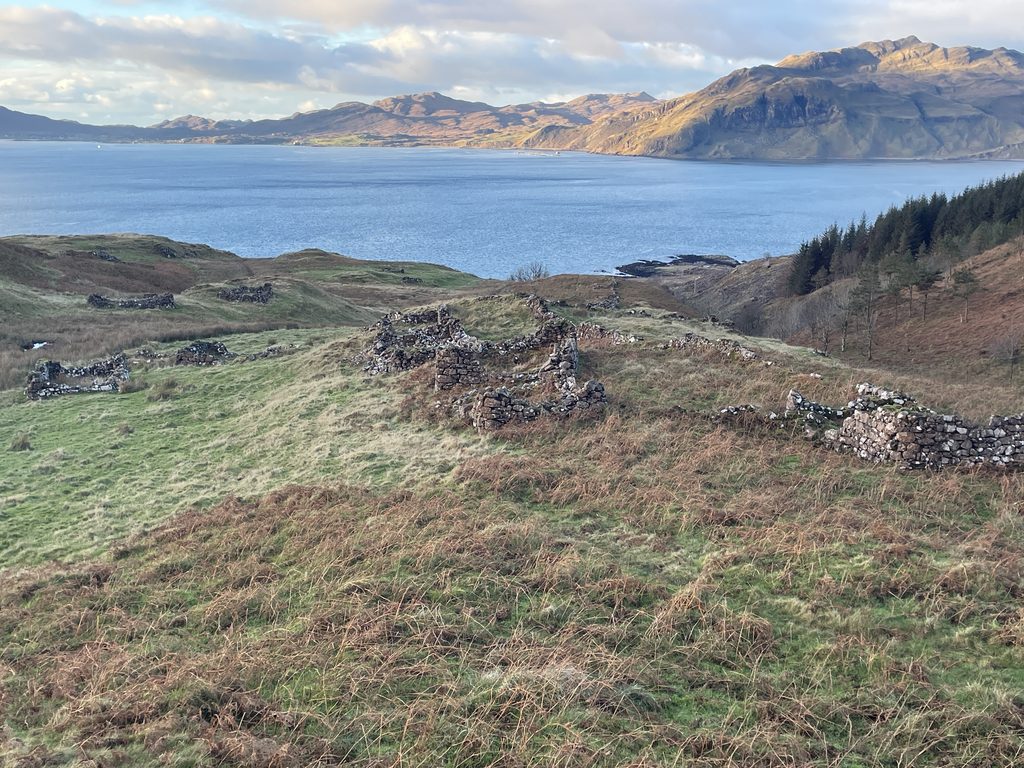
Auliston village
baile beag auliston

The township of Auliston, located on Auliston Point, was known to be occupied in 1755 and cleared in or around 1855.
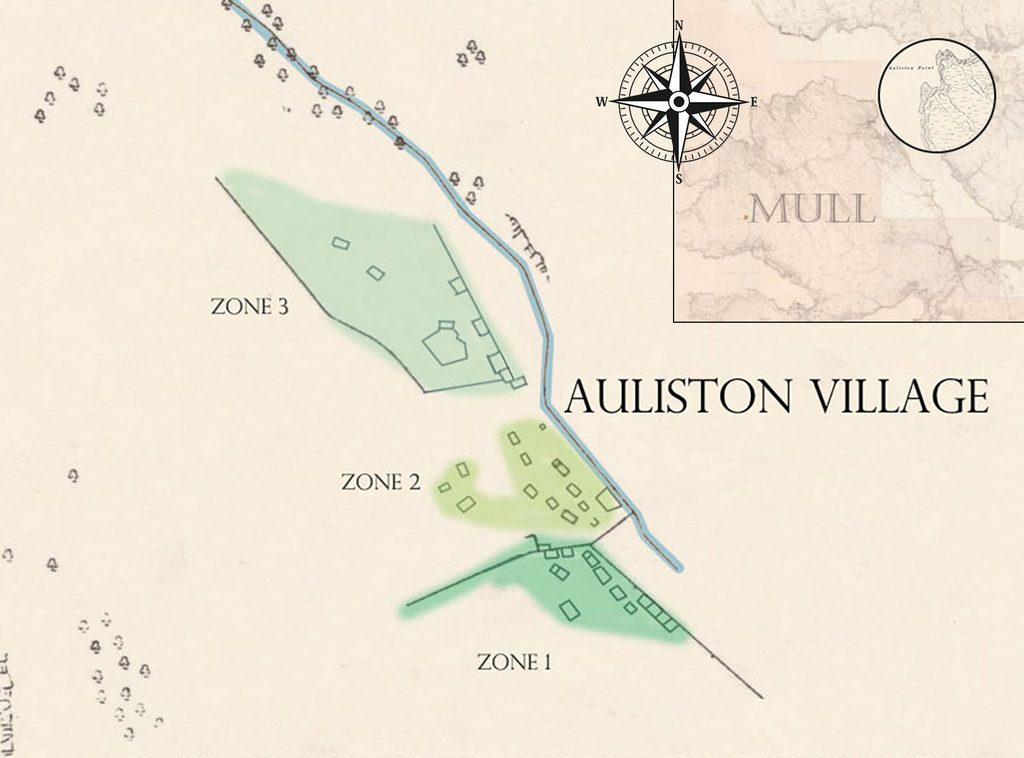
The township consisted of three clusters of buildings, suggesting it was possibly developed over time.
For ease of understanding, the site is zoned into Zone 1, Zone 2 and Zone 3.
Overall, the site today has at least 34 ruined structures still visible: small cottages, animal byres, storage barns, and a corn-drying kiln amongst them. There are also several ‘Fanks’ (animal paddocks or pens).
In 1851, the recorded population was 115 people.
Below is our interpretation of what the inside of one of the cottages at Auliston may have looked like c1850 before eviction.
Information within this scene has been taken from the book: Highland Folk Ways by Isabel Frances Grant. Isabel Frances Grant MBE (1887–1983) was a Scottish ethnographer, historian, collector and pioneering founder of the Highland Folk Museum in Newtonmore, Scotland.
when the sheep farming craze was at its height, some families were removed from the townships of Auliston and Carrick on Lady Gordon’s estate, as their places were to be added to the adjoining sheep farm. The people were removed on to the most barren spot on the whole estate, an island called Oronar on the Lochsunart side of the estate, where there was no road or any possibility of making one. They had to carry all manure and sea-ware on their backs, as the place was so rocky that a horse would be of no use. Notwithstanding all these disadvantages, they contrived through time to improve the place very much by draining and reclaiming mossy patches, and by carrying soil to be placed on rocky places where there was no soil.
Achleanan and Drimnin Mains farms were “improved’, probably in the early eighten forties, by the removal of six or seven families from each, those from the area of Auliston and Carraig being moved across the estate to Oronar Island; the people also disappeared from Portabhata and Sornagar during the same decade, but this may have been the result of the famine of 1846-7 which effected The highlands of Scotland and Ireland, also known as the potato famine. It was not until some years after Sir Charles’s death, when his widow may have felt poorer than she had done, and may also have been. influenced by the disasters of the famine years, that the evictions were authorised which drastically depopulated the estate. The figures for the total population of Drimnin Estate in the nineteenth century are revealing: there were 306 inhabitants in 1841, and 269 in 1851; but in 1861 the number was down to 118, from which it declined steadily to 58.
In 1851 the great settlement of Auliston had 115 inhabitants, including twelve crofters, living in twenty-two houses; all were evict.